
Along with the conventional heavyweights of oil and petrochemicals, Saudi Arabia is actively establishing mining as the “third pillar” of its economy. A key component of Vision 2030, this change seeks to build a fully integrated industrial ecosystem, uncover $2.5 trillion in untapped mineral riches, and diversify the kingdom’s sources of income.
The main objectives and developments of Saudi Arabia’s mining transformation are shown in the table below:
Area of Transformation Vision 2030 Goal Principal Projects & Current Advancements 💰 Economic RepercussionsReduce reliance on oil and boost the sector’s GDP contribution.The estimated value of mineral riches increased to $2.5 trillion. By 2030, the yearly GDP contribution is expected to reach $75 billion, up from approximately $17 billion in 2020.
💸 Investing and InvestigatingBy 2030, double foreign investment and bring in an additional $25 billion.Spending on exploration has surged fivefold since 2020. The new law lowers the tax rate to 20% and allows for 100% foreign ownership. rose from 104th to 23rd place in the world for investment appeal.
⚙️ Downstream Processing To capture more value than only extraction, localize mineral processing and manufacture.Concentrate on utilizing the “rare trinity” of resources, energy, and location to connect mining with industry. Ma’aden’s $110 billion ambition to increase phosphate and gold production thrice.
🤖 Future Technologies Safe supply chains for minerals essential to sustainable energy and technology (EVs, AI).Investment risk is reduced by the New National Minerals Program, which pays up to 25% of drilling expenses. collaborations for international mining purchases and supply chains for rare earths. GDP Growth and Economic Diversification
By turning its abundant natural resources into a significant source of national revenue, Saudi Arabia is transitioning from an economy reliant on hydrocarbons. Due to fresh finds and thorough geological studies, the government has dramatically raised its estimate of the kingdom’s mineral resources to $2.5 trillion. The goal is to raise the mining industry’s yearly GDP contribution from less than 3% in 2020 to approximately $75 billion. This change is intended to produce sustainable government revenue from sources other than oil and to develop new growth engines.
💸 Drawing Billions of Investment
A comprehensive redesign of the investment landscape is a key component of this transition. To increase investor confidence, the government passed a new mining investment law that permits 100% foreign ownership and reduced the corporation tax rate for mining enterprises from 45% to 20%.
These changes are effective. Between 2020 and 2024, exploration spending climbed fivefold, reaching SAR 1.05 billion ($280 million). As a result, Saudi Arabia is now ranked 23rd in the world for mining investment, up from 104th in 2013. By tripling foreign direct investment, the National Investment Strategy seeks to increase the sector’s total capital to around SAR92 billion ($24.53 billion) between 2025 and 2030.
⚙️ Establishing an Integrated Industry
The goal goes well beyond simply extracting minerals from the earth. In order to capture more value within the kingdom, the plan is to create a fully integrated mining ecosystem that incorporates regional manufacturing and processing. This strategy makes use of what officials refer to as a competitive “rare trinity”: a strategic position that lowers logistics costs for international markets, competitively priced energy for intense processing, and an abundance of geological resources.
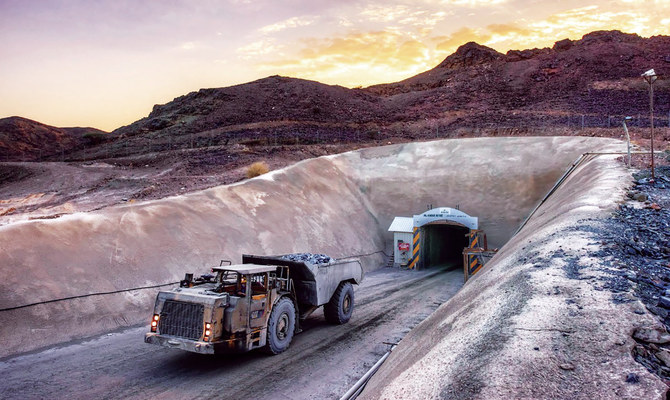
A key player in this endeavor is Ma’aden, the national mining champion, which is primarily owned by the Public Investment Fund, or PIF. It is growing into downstream processing and has proposed a big $110 billion investment plan to quadruple its production of phosphate and gold over the next ten years. As of mid-2025, the number of active mining licenses had also increased dramatically, with exploitation licenses (for production) rising 144% year over year, indicating a transition from exploration to commercial operation.
🤖 Driving Green Transition and Future Technologies
Additionally, Saudi Arabia is establishing itself as a dependable source of essential minerals required for the technological revolution and the worldwide energy shift. These include minerals necessary for robots, artificial intelligence, renewable energy infrastructure, and batteries for electric vehicles.
The kingdom has started programs like the National Minerals Program to close supply chain gaps and reduce investment risk in order to ensure its position in these future supply chains. This involves paying up to 25% of explorers’ laboratory and drilling expenses. In order to guarantee long-term access to vital minerals like nickel and copper, Saudi Arabia is also purchasing shares in foreign mining projects, such as a 10% investment in Vale Base Metals, through Manara Minerals, a joint venture between Ma’aden and PIF. Additionally, a domestic rare-earth supply chain is being developed through a relationship with US-based MP Materials.
In conclusion, Saudi Arabia’s mining transformation is a multifaceted approach that incorporates international collaborations, significant investment, and regulatory reform. In order to secure the kingdom’s position in the industries of the future, it seeks to construct a new, sustainable economic pillar from the ground up.