
Most investors assume gold and silver mining stocks are simply a “leveraged” way to bet on rising metal prices. However, the reality is far more complex. The key thing investors miss is that miners are businesses first—and like any business, they face operational, financial, and managerial risks that can completely decouple their stock performance from the price of the commodity they sell .
Here are the critical, often-overlooked factors that separate winning miners from laggards—and even physical metal itself.
1. Leverage Cuts Both Ways (And Harder on the Way Down)
While it’s true that mining stocks can outperform during a rally due to operating leverage (a fixed-cost base amplifying profit growth), this leverage is a double-edged sword.
- The Downside is Steeper: Industry experts note that while the leverage works on the upside, it works “far better on the downside.” A small dip in the metal price can wipe out a miner’s profit margin entirely, leading to a much steeper percentage drop in the stock price .
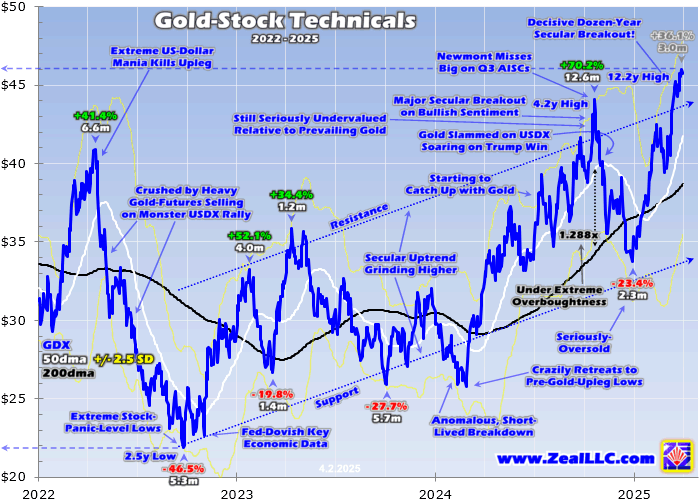
- Volatility Amplified: Recent history illustrates this perfectly. In early 2026, despite gold hitting record highs, a market correction triggered a massive sell-off in mining stocks. The VanEck Gold Miners ETF (GDX) experienced cascading stop-losses as investors rushed to lock in profits, causing shares to “decouple from their fundamental valuations” .
2. The Dilution Dilemma
Unlike owning a bar of gold, owning a mining stock means you are subject to the company’s financial engineering.
- The “Greatest Inflator”: Mike Maloney, a veteran precious metals analyst, describes mining companies as “the greatest inflators on Earth—even more so than the Federal Reserve.” This is because miners constantly raise capital by issuing new shares (private placements). While this funds operations, it dilutes the value of existing shares.
- The Cost of Capital: Even when a company is successful, this relentless dilution can destroy shareholder value. The data shows that since 1971, physical gold has outperformed top-tier mining stocks by a factor of 6.5x .
3. All-In Sustaining Costs (AISC) Are The Real Price
The spot price of gold is irrelevant if a company can’t mine it profitably. The metric that matters is AISC (All-In Sustaining Costs).
- Inflation Eats Margins: Rising costs for labor, diesel, and equipment are eroding profits. Currently, a $1,000 increase in the gold price leads to an estimated $100 increase in AISC due to price-linked royalties and production taxes .
- Margin Compression: In 2026, while Newmont boasted record 70% profit margins due to cost control, others like Hochschild Mining suffered a 16% share price drop in one day after rising AISC threatened their bottom line .
4. Management and Geopolitical Risks
Physical gold has no CEO, no board of directors, and doesn’t care what country it is stored in. Miners have all of these risks.
- Execution Risk: You are investing in a management team. Bad decisions—such as overpaying for acquisitions, poor hedging strategies (locking in prices too low), or operational mismanagement—can destroy value even in a bull market .
- Jurisdiction Risk: Many of the world’s richest deposits are in politically unstable regions (e.g., West Africa, parts of Latin America). Changes in tax regimes, nationalization threats, or local community opposition can halt production overnight. Barrick Gold, for example, faced significant headwinds in its African operations in 2026 .
5. The Junior Miner Trap
Smaller, speculative “junior” miners offer the potential for massive returns, but the risks are exponentially higher.
- The Exploration Gamble: Many junior miners never actually build a working mine. They are essentially exploration companies that rely on continuous capital raises to survive. If they fail to find economically viable reserves, the stock can go to zero .
- Financial Vulnerability: As seen with Hycroft Mining in 2026, exploration-stage companies often do not generate revenue and require constant funding, making them highly susceptible to credit crunches or rising interest rates .
Summary: How to Avoid the Traps
If you decide to invest in miners rather than (or in addition to) physical metal, investors should focus on these fundamentals rather than just the price of gold:
Ultimately, physical gold and silver are wealth insurance—they sit outside the financial system. Mining stocks are equity investments—they are part of the system and carry all the operational complexity that comes with it