
This is a thorough examination of how the Sandvik MC431 Continuous Miner is being lauded as a game-changing device for Australia’s underground mining industry, with an emphasis on its technical features, operational benefits, and particular answers to persistent industry problems in Australia.
The Challenge of Australia
It is essential to comprehend the issue before comprehending the revolution. Underground coal mining in Australia, especially in NSW and QLD, is distinguished by:
more difficult cutting circumstances (compressive strength and abrasiveness).
strict rules for methane drainage.
Automation is becoming more and more necessary as a result of the lack of skilled workers.
high criteria for roof support density.
In these circumstances, traditional continuous miners frequently have excessive vibration, high pick wear, and slow advance rates.
How These Issues Are Resolved by the MC431
For the Australian market, the Sandvik MC431 is a paradigm leap in cutting power and structural integrity rather than merely a minor improvement.
- The Revolution of “Power-to-Weight”
A huge 430 kW (575 HP) cutting motor is a feature of the MC431.
The Impact: This power enables deeper sumping and faster cutting speeds without stalling in Australian medium-to-hard coal and interburden (stone). The MC431 cuts 15–20% less time per roadway meter than the industry-standard 350–400 kW machines.
- The Advantage of “Controlled Cutting”
The device makes use of Sandvik’s Mechanical Oscillation Damping System (MODS), which is patented.
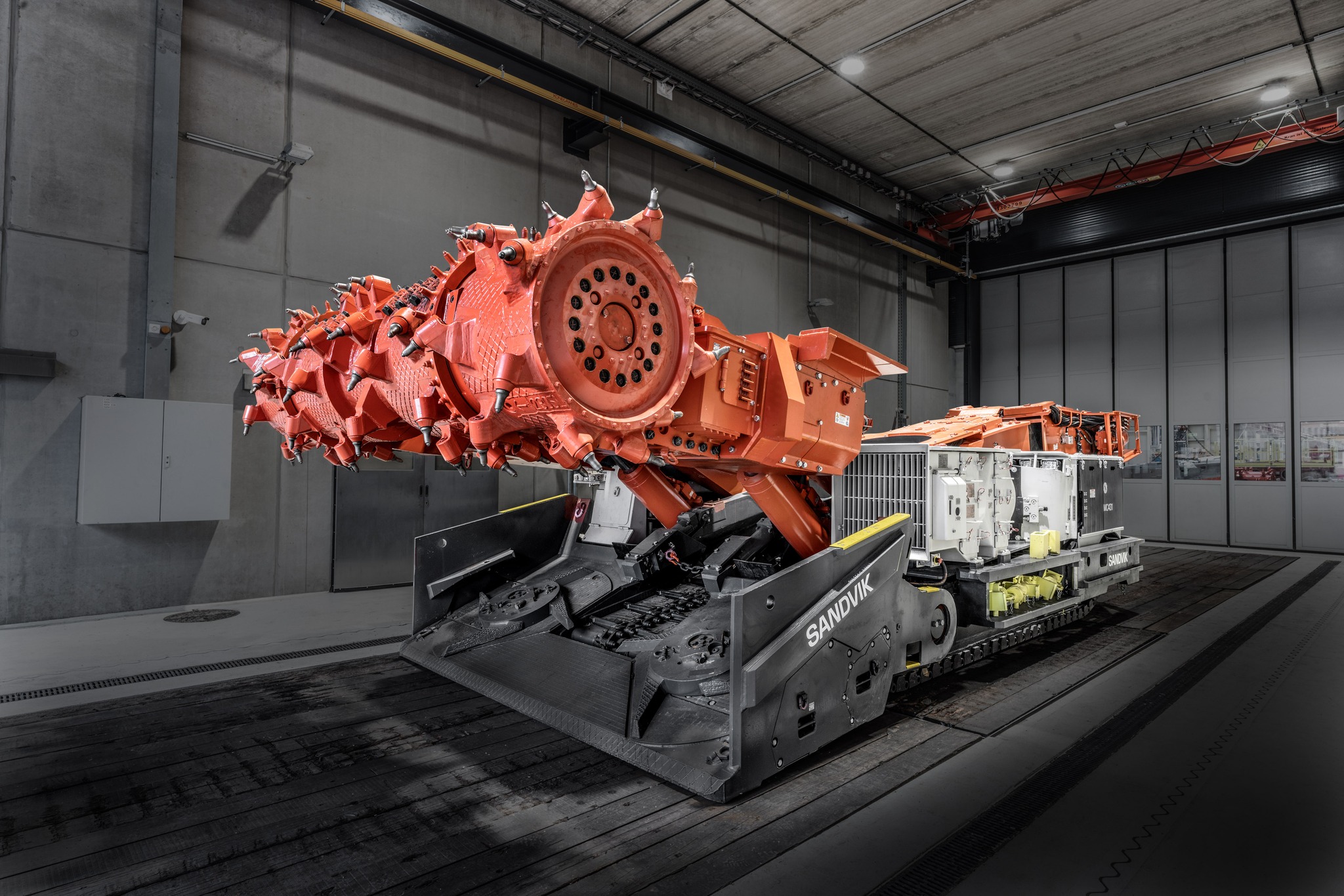
The Australian Problem: Excessive vibration leads to premature pick failure, structural fatigue, and operator fatigue.
The solution is to separate the cutter head mass from the chassis using MODS. This has significantly decreased structural stress and increased pick life in abrasive Bowen Basin coal by up to 40% in Australian experiments.
- Sandvik AutoMine, or smart automation
The MC431 was created with Level 4 Automation in mind.
Remote Operations: Operators might be situated in a surface control room in Mackay or Brisbane, away from the heat, noise, and dust.
Corridor Development: The device cuts exact roads without the need for human guiding by using laser scanning and navigation. This is crucial for Australian mines seeking “hands-off” growth.
- Integration of Ground Support
Modern roof bolting rigs, such as the Sandvik RB3 series, may be integrated immediately on the trailing platform of the MC431 thanks to its heavy-duty, full-width chassis. This eliminates the requirement for specialized bolting shifts by creating a semi-mechanized cycle: cut, bolt, move, repeat.
Case Study: Use in the Bowen Basin of Queensland
Early usage by large miners, such as Peabody and Anglo American, has demonstrated:
Advance rates: In developing headings, where rivals averaged 80–90 meters each shift, up to 120 meters.
Methane management: Even at greater cutting rates, the machine’s inbuilt flooded-bed dust collector (scrubber) collaborates with external gas drainage to keep methane levels below 0.5%.
Maintenance: The complete cutter gearcase may be replaced in less than 8 hours because to the modular design, a significant decrease from the 24+ hours required for prior models.
Why the Word “Revolutionises” Is Correct
The MC431 performs three functions for Australian underground mining that no other device of this size has:
The “hard rock” barrier is broken. Instead of having to blast, Australian miners can now handle medium-strength stone as regular cutting.
Single-pass full-seam extraction is made possible by it. It can cut a roadheader-style face 4.5 meters high in a single lift thanks to its strong sumping capabilities, which lowers the number of cuts every cycle.
It makes labor future-proof. It reduces the possibility of a labor shortage by enabling full remote operation.
The Decision
Being the first continuous miner designed especially for the high-abrasion, high-stress geology of Australian main seams, the Sandvik MC431 is transforming underground mining in Australia. The industry is moving away from “reactive maintenance and manual cutting” and toward “predictive automation and high-performance development.”
The formula is straightforward for mine managers: reduced cost per tonne, quicker longwall panel preparation, fewer development headings, and safer operations.