
Importing heavy equipment (construction, mining, agricultural, or industrial machinery) into Ghana requires multiple stages and licenses. A structured overview of the prerequisites, relevant permits, roles, and clearance process is provided below.
- Regulatory Framework and Key Agencies.
The Customs Division of the Ghana Revenue Authority (GRA), the major enforcement organization, employs the ICUMS (Integrated Customs Management System).
The Ghana Standards Authority (GSA) runs the Ghana Conformity Assessment Programme (G-CAP), which requires pre-shipment inspection for the majority of items.
The Ministry of Trade and Industry (MOTI) issues import permits for old products and banned commodities.
The Environmental Protection Agency (EPA) may be involved if the equipment is used, designated as electronic/electrical, or causes an environmental danger.
If the heavy equipment is self-propelled and requires road registration, contact the Driver and Vehicle Licensing Authority (DVLA) and the Motor Transport and Traffic Department (MTTD).
- Key Permits and Certificates are Required.
a) Certificate of Conformity (CoC) or Pre-Shipment Inspection
According to G-CAP, all imported items (including new heavy equipment) must undergo pre-shipment inspection in the country of supply by an approved inspection company.
Bureau Veritas
SGS
Intertek
A successful inspection generates a Certificate of Conformity (CoC), which is required for customs clearance. Without it, the consignment risks incurring a penalty of up to 30% of the CIF value and being rejected.
a) Import Permit for Used Heavy Equipment
Ghana limits the import of old heavy machinery. You will most likely require an Import Permit from the Ministry of Trade and Industry. Permits typically require:
Pro forma invoice
Evidence of the machine’s year of production, model, and serial number
A statement regarding the condition and planned use.
A “Destruction Certificate” from the exporter’s nation may be required (for old engines/electrical parts) to demonstrate that it is not e-waste.
While not regularly defined, customs and MOTI frequently apply a 10-year age limit to used earthmoving and construction equipment (from the date of production). Equipment older than ten years may be denied an import permit or face further scrutiny. Always consult a clearance agency to ensure that current practices are followed.
c) Environmental Permit (if required)
Used equipment that includes motors, hydraulic systems, or refrigerants may require an EPA clearance. This is more typical with generators, air conditioners, and refrigeration machines. The EPA is normally not engaged with standard excavators, bulldozers, and other equipment unless it is classified hazardous waste.
d) Import Declaration Forms (IDF)
After obtaining the required permits, you must submit an Import Declaration Form (IDF) via the ICUMS portal. The IDF requires:
Valid Tax Identification Number (TIN).

Pro forma invoice
Bill of lading / airway bill
Packing list
CoC number
Import Permit (if used)
Before the items arrive, the IDF creates a Customs Classification and Valuation Report (CCVR), which confirms the HS code, value, and appropriate duties.
a) Special Registration of Road-Going Equipment
If the heavy equipment will be driven on public roads (for example, mobile cranes, wheel loaders, road graders), it must be registered with the DVLA and may require a separate Vehicle Import Permit and roadworthiness certificate. Check the HS code categorization to distinguish between stationary plants and motor vehicles.
- Step-by-Step Import Procedure
Register as an importer with GRA (obtaining a TIN and Customs House Agent code, or hiring a licensed agent).
Determine your equipment’s specific HS Code (for example, 8429 for bulldozers and 8705 for special purpose vehicles). The code sets tariff rates and determines whether an import authorization is required.
Obtain a pre-shipment inspection from an authorized G-CAP inspector in the exporting country, then secure the Certificate of Conformity.
Apply for an Import Permit from MOTI (if equipment is utilized or banned). This could be handled by a local partner or the clearing agent.
File the IDF in ICUMS and get the CCVR.
Ship the products while verifying that all original paperwork are with the consignee or agency.
Clearance at the port: The customs agent enters the declaration into ICUMS, pays duties/taxes, and arranges for physical examination (often scanning or manual inspection) and release.
- Duties and Taxes for Heavy Equipment
Taxes are based on the CIF value (cost + insurance + freight). Typical structure:
Component Rate
Import Duty: 0%, 5%, 10%, or 20% based on HS code. Many heavy machinery products (HS 84.29, 84.30, and 87.03) are subject to a duty of 5% or 10%. Some agricultural machinery (HS 8432, 8433) may be duty-free under certain conditions.
VAT 15%
NHIL (National Health Insurance levy)2.5%
GETFund Levy: 2.5%
COVID-19 Health Recovery Levy: 1%.
The total indirect tax is 21% (based on the sum of CIF and import duty).
Other charges include the ECOWAS Levy (0.5%), EDIF Levy (0.5%), network charges, and inspection fees.
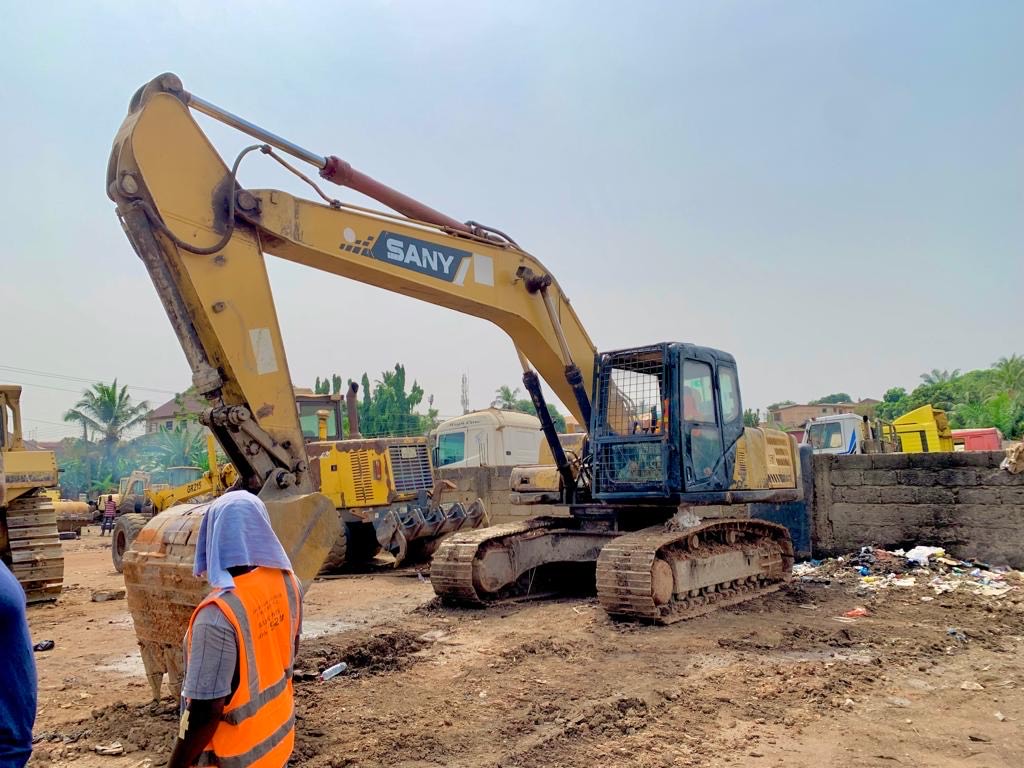
Example computation for a $100,000 excavator (HS 8429.52, CIF, 5% duty):
Import Duty = 5% × $100,000 = $5,000
The total of VAT, NHIL, GETFund, and COVID levy is $22,050, calculated as 21% of $100,000 + $5,000.
Total taxes are around $27,050, plus tiny statutory levies.
Exemptions: Mining support companies and large-scale agricultural projects can apply for import duty and VAT exemptions through the Ghana Investment Promotion Centre (GIPC), the Minerals Commission, or the Ministry of Food and Agriculture, if the equipment meets specific legislative requirements. Used equipment is rarely eligible for complete exemption unless it is part of a pre-approved investment agreement.
- Practical Tips
Always utilize a certified customs agent who is experienced with Takoradi, Tema, or Kotoka Airport clearance, as large equipment frequently requires physical examination and approval from certain sheds.
Pre-inspection is non-negotiable. The CoC must match the equipment description accurately; any differences result in demurrage and penalties.
Used equipment documentation: You may require a “Certificate of Non-Objection” or a “Statement of Condition” from the exporter to demonstrate that the equipment is working and not scrap.
Demurrage and storage costs: Charges at Ghana ports increase dramatically after the free time (often 3-5 days). Prepare all permits before the vessel arrives.
ECOWAS origin: If the equipment is built or has significant value added in an ECOWAS member state, it may be eligible for duty-free entry under the ETLS. However, heavy equipment is rarely of ECOWAS origin; please establish eligibility ahead of time.