
Just 13 of the 907 crucial mining projects in the country’s pipeline might make a final investment decision (FID) in the next two to four years, according to PwC Australia.
According to its most recent report, projects are moving too slowly, endangering Australia’s capacity to satisfy demands from trading partners and allies.
PwC Australia Energy, Utilities & Resources Partner Lachy Haynes told Mining.com.au that the investigation started with a sovereign investor looking for Australian minerals to assist its domestic battery supply chain.
“Can we get serious now?” is the report written by Haynes. safeguarding Australia’s vital mineral future.
“When we looked at the entire Australian mining value chain, from exploration to production, we discovered that there were many projects in this space, but actually few in those final stages of getting to FID,” says Haynes.
Within its “investable universe,” PwC finds 117 initiatives, or around one in ten or 13% of the total. With a principal commodity on the Australian Government’s vital or strategic minerals list, these projects have advanced past exploration but have not yet reached FID.
With more complicated initiatives perhaps requiring up to ten years, about 90% of those projects are three to six years from FID. About 36% are in the Scoping Study stage and 53% are in the Prefeasibility Study (PFS) stage.
According to Haynes, “the development of Australia’s critical minerals pipeline is not keeping pace with demand.”
Australia’s hunt for vital minerals faces a gap between investment and policy.
According to PwC, since 2022, the Australian government has invested $28 billion in the critical minerals and rare earths industry through programs such the Critical Minerals Strategic Reserve, Critical Minerals Production Tax Incentive, and Critical Minerals Facility.
The study does point out a discrepancy between investing choices and policy. Many earlier-stage developments lack the necessary backing because a large portion of that support is prospective, conditional, or structured as tax incentives that only provide value after projects start producing.
According to Haynes, key minerals are now at the center of government agendas that go beyond the energy revolution to include artificial intelligence (AI), automation (productivity), commerce and industrialization (growth), and defense (security).
He claims that although Australia possesses the resources that the world needs, it must transform this endowment into a financially viable supply for its trading partners and friends.
Although the nation’s success in bulk commodities lays the groundwork, Haynes contends that Australia must think about the future of not only mining but also midstream processing and downstream sectors.
According to Haynes, “being able to capitalize on the entire critical minerals value chain puts Australia in a privileged geopolitical and economic position with our trade partners and allies and allows us to maintain that position as a partner of choice.”
“If we are unable to provide these minerals, there is a risk that these partners will find them elsewhere.”
According to PWC’s “Aussie Mine 2025” study, the project pipeline as a whole has hardly advanced. There are 675 exploration or reserve development projects, 87 production projects, and 20 construction projects out of the 907 total important minerals projects that have been identified.
Eight processing facility projects, or just 1% of the total, are also identified by the investigation.
Six upstream projects—four lithium projects, one rare earths project, and one base and technology metals project—reached FID between 2022 and June 2026. According to PwC, the remaining five did not attain the milestone between March and June 2026 for about four years.
Additionally, only three essential minerals make up the majority of Australia’s investable universe. Rare earth elements make up 10%, nickel makes up 15%, and copper makes up 29%. Projects including vanadium, tin, graphite, lithium, zinc, and cobalt account for an additional 31%.
Project pipeline is impacted by funding, scale, and time.
Australia’s primary advantage is that it continues to be a resource partner of choice for many allied nations, which is why the nation cannot allow its crucial mineral future to pass. According to PwC, the nation is bolstered by its mineral wealth, track record as a dependable supplier, and comparatively low sovereign risk.
However, those benefits do not eliminate the obstacles to progress. Funding, according to Haynes, is just one aspect of the problem.
“We highlight our scale challenge in the report.” Haynes says.
There aren’t many credit-worthy players because these are smaller enterprises and the explorers and developers usually have smaller balance sheets.
“We don’t frequently see that kind of major player in the critical minerals market, but companies like Rio Tinto (ASX:RIO) and BHP Group (ASX:BHP) have these large balance sheets and decent access to financing.
“So, funding may be the main problem, but when you look at it, it also comes down to scale and the participants’ creditworthiness.”
Another limitation is time. Before construction and commissioning can start, projects must go through resource definition, technical assessments, and funding.
According to Haynes, “that process has been stretched out for a long period of time and remains so today.”
According to Haynes, production speed is becoming more and more crucial. Being the cheapest is not as important as being able to offer something in the time frames that end users desire.
According to Haynes, “Australia is taking concrete steps to diversify its supply chain, but that has to come with some urgency and intent.”
And our trading partners undoubtedly view it that way. Finding strategies to maintain the same level of urgency and focus as our trading partners is our problem.
The issue is not specific to Australia. On a local level, however, labor costs and availability, energy prices, and the cost of constructing new infrastructure are making it more difficult to get projects into production.
Strategies to expedite the future of our vital minerals
Fast-tracking projects, creating shared infrastructure areas, reshaping investment proposals, and repurposing aging industrial buildings are the four solutions outlined by PwC to improve Australia’s vital resources pipeline.
The first entails reconsidering land-use, permitting, and investment choices in order to expedite uncontested projects while upholding regulatory oversight.
In contrast to stand-alone projects, the second focuses on precincts. Shared infrastructure could increase project economics by distributing capital needs among multiple businesses.
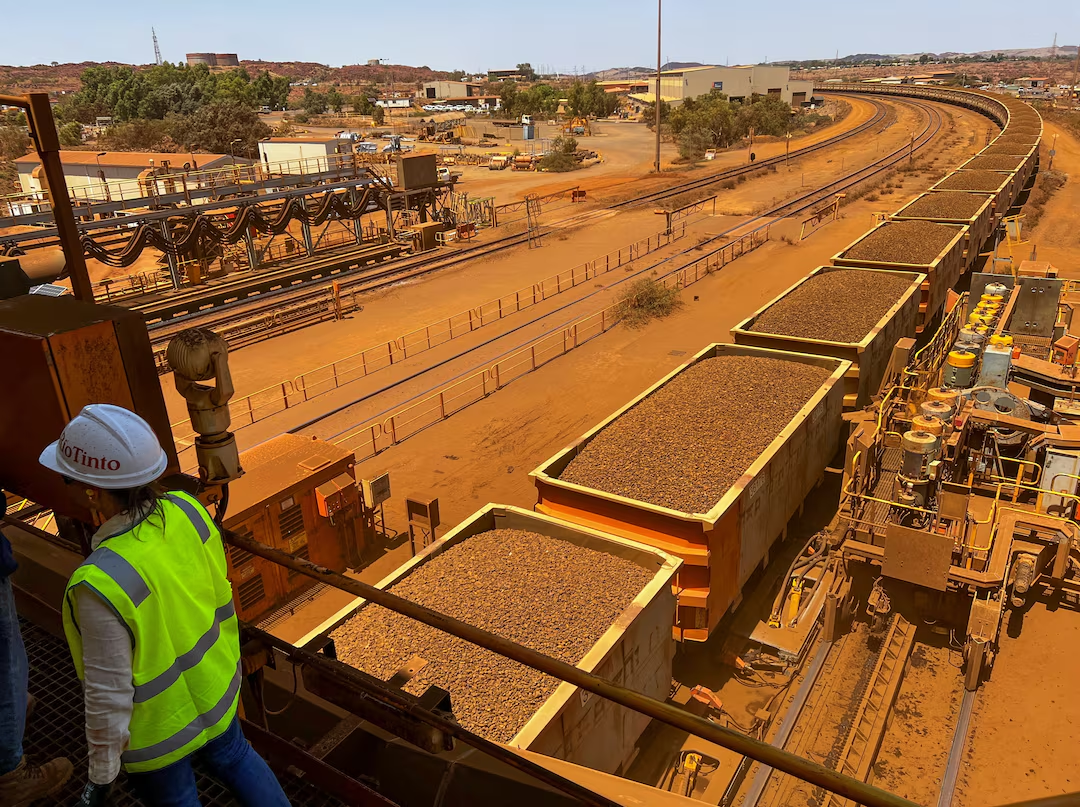
According to Haynes, the aggregation processes employed in some of Australia’s largest iron ore basins should serve as a model for the critical minerals sector.
According to Haynes, “if mines are nearby, they could look to operate in some sort of cluster or precinct hub, solving for some of these infrastructure issues like energy, water, and logistics at once and hopefully getting some of the benefits of scale that way.”
Rethinking investment concepts to appeal to institutional investors, superannuation funds, and sovereign wealth funds is the third tactic.
According to Haynes, “we need to be more creative in unlocking sovereign wealth and superannuation funds because it’s the long-term patient capital that’s needed here.”
According to Haynes, “this type of capital hasn’t typically gravitated toward commodity risk, so a bit of thought is required to get some credit into this space.”
PwC’s final recommendation focuses on repurposing ageing industrial facilities to capture downstream opportunities — “to boost upstream option values, to maintain Australia’s position as a critical minerals partner of choice, and secure added value for Australians”.
This kind of integrated critical minerals value chain is currently sought after by numerous governments worldwide in order to improve supply security and generate chances for domestic value addition.
Haynes plans to increase Australia’s capacity for midstream processing.
“It would be fantastic if Australia could successfully extract the minerals and push them directly into the midstream.” If we are unable to develop an integrated solution that benefits both Australia and our allies, I believe we will lose out on a significant portion of the opportunity.
In PwC’s assessment, Australia’s critical minerals sector sits at a crossroads: the nation has the geology, geopolitical advantages, and government backing, but without faster movement through the project pipeline, those strengths risk being squandered.
PwC has issued a clear warning: ambition must be matched by urgency and intent. Unlocking capital, streamlining approvals, and building midstream capacity could strengthen Australia’s role as a partner of choice in global supply chains. Further delays, however, could see allies look elsewhere, leaving Australia watching from the sidelines as the critical minerals race accelerates.